
Before anything else on this page, the fact that matters most to anyone thinking about this scheme:
Asian Fab Tec Limited is not a real-estate developer. It is an engineering and contracting company, and the Doddabele scheme is its first known residential project.
That is not a criticism of the company. It is a description of it. Asian Fab Tec has a real, checkable industrial history going back to 2000, and it has filed for this land properly and in its own name. But it has no completed homes, no registered residential projects, and no handover record. A buyer weighing a pre-launch commitment here is being asked to price the execution risk of a first-time residential developer, and no amount of careful writing on our part can substitute for that being said plainly.
What the record shows about Asian Fab Tec Limited's residential experience
No residential track record exists, on three independent measures in any of them.
| Public record | What it shows |
|---|---|
| The Karnataka RERA register | No entry for Asian Fab Tec Limited — no registered project, at any stage, anywhere in Karnataka |
| The company's own website project list | Exactly one entry: Sira Solar Projects. No residential scheme is listed |
| Press and trade coverage | Nothing credible naming Asian Fab Tec as the developer of a housing project |
Three independent negatives are worth more than one. A company can be absent from a registry for administrative reasons; it is far less likely to be simultaneously absent from the state registry, absent from its own portfolio page, and absent from the trade press if it has in fact built and handed over homes.
The practical consequence for a buyer is concrete. There is no earlier Asian Fab Tec residential project to walk through. There is no completed tower whose lift lobbies, water pressure, parking ramps or basement waterproofing you can inspect several monsoons after handover. There is no owners' association to ask about snag lists and maintenance transition. There is no previous handover date to compare against a previous commitment. Every one of those is a normal due-diligence step for a Bengaluru buyer, and none of them is available here.
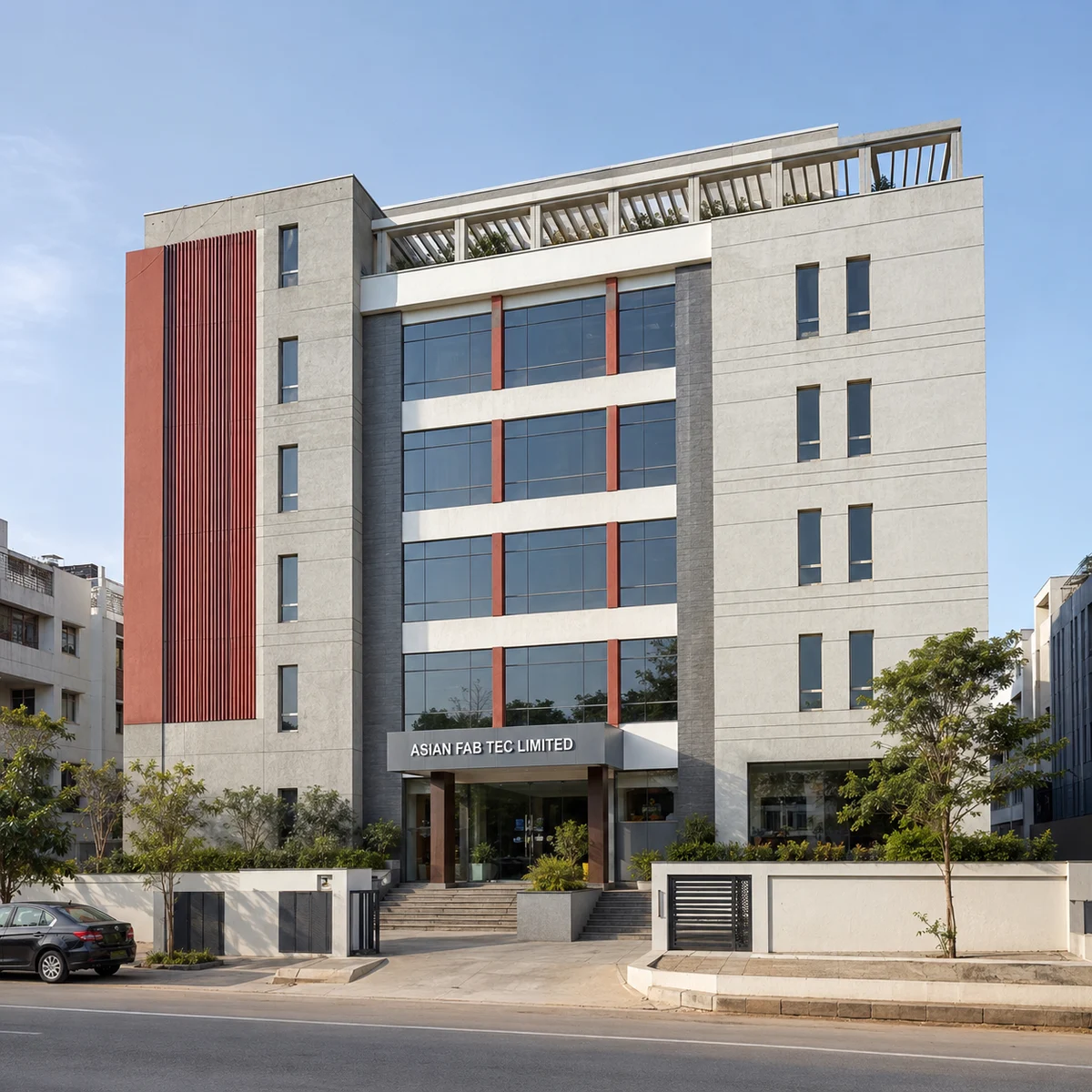
What Asian Fab Tec Limited verifiably is
The company describes its own origins on its website, and the account is consistent with the name history. It was incorporated on 14 August 2000 as Asian Cylinders Limited, a limited company under the Companies Act, with a stated main object of manufacturing LPG cylinders in various sizes, together with power projects, construction and fabrication. The name was changed to Asian Fab Tec Ltd with effect from 10 February 2006.
| Field | Value |
|---|---|
| Incorporated | 14 August 2000, as Asian Cylinders Limited |
| Renamed | Asian Fab Tec Ltd, with effect from 10 February 2006 |
| Original main object | LPG cylinder manufacture, with power projects, construction and fabrication |
| Registered office | Plot No. 15, II Phase, Peenya Industrial Area, Bengaluru 560058 |
| Founder named on its own About page | Mr K. H. Puttaswamy Gowda |
| Its own site's page title | "Asian Fab Tec – Electrical Contractor" |
| Business divisions | Four: power projects, construction, fabrication, solar PV |
| Listed projects on its own site | One: Sira Solar Projects |
| Residential track record | None found |
Two details in that table deserve to be read carefully, because they are the ones most easily misused.
The first is the word construction in the company's original objects. A memorandum object clause is a statement of what a company is permitted to do, not a record of what it has done. "Construction and fabrication" in a cylinder manufacturer's objects, alongside power projects, points at industrial structures and plant work. It is not evidence of homebuilding, and we do not read it as such.
The second is the company's own page title, which presents Asian Fab Tec as an electrical contractor. That is the company describing itself, in the most prominent piece of metadata on its own website, in 2026. When a business wants to be understood as a property developer, that is generally the first place it says so. This one does not.
Put together, the honest description is: a Peenya engineering contractor operating since 2000, with four industrial divisions — power projects, construction, fabrication and solar photovoltaics — that is now, for the first time on the public record, promoting a residential development.
The Peenya registered office, and why the address is worth checking
Asian Fab Tec Limited's registered office is Plot No. 15, II Phase, Peenya Industrial Area, Bengaluru 560058. That address appears identically in three places: on the signed certificate for the Doddabele land, in the application form lodged with the public environmental record, and on the company's own website.
This sounds like housekeeping, and it is not. Name collisions are common in Indian corporate records, and a buyer checking a developer's history can easily end up reading about a similarly named company in another state. The address match is what ties the entity that filed for this land to the operating company that runs the Peenya business. It is the same legal person, not a similarly named shell. Where our reading of the record is favourable to the developer, we would rather say so explicitly — this is one of those places.
Principals of Asian Fab Tec Limited, as the company names them
The company's own About page names Mr K. H. Puttaswamy Gowda as its founder. That is the single principal we can attribute to a primary source, and it is therefore the only one this page names.
Company-data aggregators carry director lists, revenue estimates, employee-count bands and industry classification codes for Asian Fab Tec Limited. We publish none of them. They are scraped derivations rather than filings, they disagree with each other on basic figures, and a wrong number about a developer's finances is precisely the kind of thing a buyer would reasonably rely on. Where we cannot see the source document, we would rather leave a gap on the page than fill it with something that looks authoritative and might not be.
For the same reason we do not publish a corporate identification number sourced only from an aggregator profile.
One inference we will offer, labelled as one: the company's name ends in "Limited" without "Private", which on the ordinary reading of the Companies Act points to a public limited company rather than a private one. We have seen no indication that its shares are listed on any exchange. So our reading — and it is a reading from the name form, not from a filing we have examined — is that this is an unlisted public limited company. The name should never be written with "Private" inserted into it: that is a different name, and potentially a different company altogether.
What Asian Fab Tec Limited has actually filed for the Doddabele land
Whatever the company lacks in residential history, its regulatory paperwork for this parcel is real, signed and traceable. Three filings exist on the public environmental record, all in the name of Asian Fab Tec Limited, all on the same 6.2624-hectare parcel at Doddabele.
The operative filing:
| Field | Value |
|---|---|
| Status | Standard Terms of Reference granted 8 July 2026 by the state environmental authority |
| Applied | 6 July 2026 |
| Category | B1 |
| Schedule | 8(b), Townships and Area Development Projects |
| Project name on the file | "Residential Apartment With Club House And Amenities" project |
| Promoter | Asian Fab Tec Limited |
| Land | 6.2624 ha, which is 15.47 acres |
| Built-up area | 287,985.28 sq m |
| Declared project cost | Rs 526.27 crore |
| Survey numbers | Sy No. 7/2, 7/3, 7/4, 7/6, 7/1A, 7/1B |
| Village | Doddabele Village, Kengeri Hobli, Bangalore South Taluk, Bangalore Urban |
An earlier Terms of Reference for the same parcel was granted on 9 March 2026 under file. It recorded the same 6.2624 hectares, a built-up area of 273,029.69 sq m and a project cost of Rs 562.67 crore, and its survey-number field was left blank. Both filings are real and both are on the record; the July one supersedes the March one, and the figures in the table above are the operative set. Our own arithmetic on the two, offered as arithmetic and nothing more: the operative filing carries about 14,955 sq m more built-up area and about Rs 36 crore less declared cost than the superseded one, and it fills in the survey numbers the earlier certificate left empty.
A third filing is an environmental clearance application lodged on 21 April 2026. Its status is "Referred to the state environmental authority". It is undecided.
That distinction is important and is routinely blurred in marketing material, so we will be explicit. A granted Terms of Reference is not an environmental clearance. A ToR is permission to carry out the environmental impact study and a specification of what that study must examine. The certificate itself records that a ToR does not amount to approvals, consent or permissions. The correct statement of where this project stands is: Standard Terms of Reference granted 8 July 2026, and the environmental clearance application remains under consideration.
Two things follow for a reader assessing the developer. First, the company has engaged with the statutory process properly and in its own name, twice, and the paperwork is internally consistent. That is a point in its favour. Second, no filing anywhere in this set states a unit count, a tower count, a floor plan or a price. The scheme's programme has simply not been disclosed yet.
Promoter structure: the filings name the operating company itself
It is worth explaining how developer entities usually work in this market, because the arrangement recorded here is not the common one.
Many Indian residential projects are not filed by the brand you see on the hoarding. They are filed by a special purpose vehicle — a company or limited liability partnership formed for that one scheme — or by a partnership between the landowner and the developer under a joint development agreement. There are sound reasons for it. An SPV ring-fences one project's liabilities from the rest of the group, it gives a landowner a clean way to hold a revenue or area share, and it lets a lender take security over a single project without entangling the parent. RERA registers the promoter entity, so the company a buyer actually signs a sale agreement with is frequently a project-specific vehicle rather than the well-known parent. This is normal practice, not a warning sign — but it does mean the balance sheet standing behind your agreement may not be the one whose reputation persuaded you.
On the filed record for this land, both Terms of Reference name Asian Fab Tec Limited itself as the promoter. No special purpose vehicle appears anywhere we could see. The applicant is the operating company — the same legal person that runs the Peenya engineering business, from the same registered office.
For a buyer that cuts both ways, and both sides are worth stating. The whole operating company stands behind the filings, rather than a thinly capitalised project entity formed last year. Equally, the entity promoting the scheme is one whose income has come from contracting work, not from selling homes, and whose other divisions carry their own commercial exposures.
There is also a live question rather than a settled fact here. Because the project is not registered with K-RERA, nobody outside the company yet knows which entity will appear as promoter on the registration application when it is made. It may be Asian Fab Tec Limited, matching the environmental filings. It may be an SPV formed for the purpose. If it is an SPV, the counterparty on a buyer's agreement would be a new company with no operating history at all, and the strength of that arrangement would depend entirely on what guarantees the parent gives. Ask the question directly, and ask for the answer in writing.
What this record does and does not tell you about Asian Fab Kengeri
Here is our frank assessment, separated into what plausibly carries over from the company's existing business and what does not.
What plausibly carries over. An electrical and fabrication contractor that has been operating since 2000 knows how to run a construction site. Procurement, subcontractor coordination, materials scheduling, site safety, dealing with statutory inspectorates, and the discipline of building to a specification against a deadline are all real competencies, and they are not trivial ones. Structural and electrical work on a residential tower is work this company's divisions are closer to than most first-time developers would be. A firm coming into residential development from industrial EPC starts with more relevant skill than one coming in from an unrelated trade.
What does not carry over. Residential development is a different business from contracting, and the differences fall exactly where a homebuyer is exposed. Selling to hundreds of individual buyers means RERA compliance, escrow discipline on collections, and a sales and documentation function that a contractor has never needed. Quality tolerances are judged differently: an industrial client signs off on performance, whereas a homeowner inspects a skirting line and a bathroom fall at close range for years. Then there is everything after construction — common-area handover, association formation, maintenance transition, and defect liability, all of which are obligations a developer carries long after a contractor's job would have ended. Finally, the money works differently. An EPC contractor bills milestones to one institutional client; a residential developer funds a long build from staged payments by many individual buyers, and that working-capital pattern is where first-time developers most often come unstuck.
And the scale is not modest. This is not a small first project. On the operative filing it is 15.47 acres carrying 287,985.28 sq m of built-up area, at a declared project cost of Rs 526.27 crore. Converted, that built-up figure is about 3.10 million sq ft — our arithmetic, at the standard 10.7639 sq ft to the square metre. Entering residential development at that size is a large step for a company with no residential registrations behind it. We state that neutrally: it is a fact about the scale of the undertaking, not a prediction about the outcome.
What a buyer can actually do about it. Some of the uncertainty here is reducible by asking. Ask which entity will hold the K-RERA registration. Ask who the main contractor, project management consultant, structural consultant and architect will be — a first-time developer transfers a good deal of execution risk through whom it hires, and those names are checkable in a way the developer's own residential record is not. Ask for the sanctioned plan and the name of the sanctioning body; the authority for this site is not recorded in any document we were able to obtain, and Doddabele sits at the edge of the Greater Bengaluru Authority boundary in a belt where the 2025 reorganisation has left jurisdiction unsettled. Ask to see the environmental clearance once it is granted, rather than accepting the Terms of Reference as though it were one. And note what any of this is worth before registration: nothing you are told now is enforceable against the developer under the Act until the project is registered.
K-RERA registration status of Asian Fab Kengeri
This project is not registered with the Karnataka Real Estate Regulatory Authority. There is no registration number, and no pending application that we could find. Section 3 of the Real Estate (Regulation and Development) Act 2016 is unambiguous that a project in a registrable class may not be advertised, marketed, booked or sold before registration is granted. So there is nothing here to book and nothing to buy. This site exists to set out what is actually on the record about a scheme at the approvals stage, and to take enquiries from readers who want to be told when that changes. It is not a booking channel, and no payment should be made to anyone on the strength of anything written here.
What the public record shows about Asian Fab Tec Limited
Every claim on this page can be verified independently, and we would encourage it.
The environmental filings are on the public environmental record and are searchable on the public record; the granted Terms of Reference are digitally signed documents that carry the promoter name, the survey numbers and the land extent on their face. The Karnataka RERA registry is searchable by promoter name, and a search for Asian Fab Tec Limited is what returned nothing. The incorporation history, the founder's name, the registered office, the division list and the single listed project all come from the company's own website, which is the source we would want a buyer to read directly rather than take from us.
If the position changes — if an environmental clearance is granted, if a K-RERA registration is issued, if the promoter entity turns out to be a special purpose vehicle, or if the company publishes a residential portfolio we could not find — this page will be updated to say so, and the change will be dated.
Asian Fab Kengeri Developer FAQs
How many towers will there be, and why can you not tell me?
We cannot tell you because the sources contradict each other and none of them is primary. The pre-launch material in circulation states one tower count in its main body and a materially smaller number of residential buildings in its own USP block, a few lines away. A document that disagrees with itself is not evidence, and neither figure appears in any filing, which is why we publish neither. The document that would settle it is the conceptual plan lodged as an enclosure on the public record, which is not published. We are also not going to reason backwards from floor counts and units-per-floor, because that arithmetic is compatible with almost any answer and would dress up a guess as an inference. When the developer publishes a sanctioned plan, this will be knowable.
How large is the site, and how much is being built on it?
The filed parcel is 6.2624 hectares, which is 15.47 acres, across survey numbers 7/2, 7/3, 7/4, 7/6, 7/1A and 7/1B in Doddabele Village. The operative Terms of Reference records a built-up area of 287,985.28 sq m — about 3.10 million sq ft — and a project cost of Rs 526.27 crore. Those three figures are the most solid quantities on this entire site, because they come from a digitally signed government certificate rather than from marketing material. Note what "built-up area" means in this context: it is the gross figure including basements, parking, circulation, walls and the clubhouse, not a saleable area.
When is possession?
No possession date can be given, and we would rather say that than publish a number we cannot stand behind. The developer has declared no completion date, because a declared completion date is something the RERA registration process extracts and this project has not reached it. The launch and completion quarters that appear in the material in circulation are template defaults — the identical pair of dates appears across every other project sheet in the same batch, and the sheet labels them tentative itself. Publishing them would be publishing a spreadsheet default as a commitment. Expect a real date only when a registration certificate carries one.
What map coordinate should I use, and how precise is it?
Use 12.89549, 77.47207. That point is the centre of the parcel's filed boundary bounding box, taken from the developer's own filed boundary lodged with the environmental authority, whose extents run from 12.8939848 to 12.8970023 in latitude and 77.4703953 to 77.4737428 in longitude. Be clear about what that is: a bounding-box centre, not a surveyed centroid. The box measures roughly 334 m by 363 m and the parcel fills a little over half of it, so the point is a reliable indicator of where the land is and not a marker of any particular corner of it. We publish it to five decimal places deliberately and would not defend more. The latitude and longitude quoted in the pre-launch material falls outside the filed bounding box altogether and should be discarded.
What about the railway station and the bus terminal?
Kengeri railway station is 3.67 km by road and Kengeri Bus Terminal is 4.64 km by road, which makes this one of the better-served pockets on the corridor for a village address — a suburban rail stop, a major bus terminal and a metro terminus all inside 5 km. Further up the Purple Line, Jnanabharati is 7.12 km by road, Pattanagere 7.68 km and Mysore Road station 9.71 km. Every figure on this page is routed road distance, not straight-line, and we give kilometres rather than a single drive-time number because free-flow and peak journey times on this stretch differ by a factor of two or more.